In 2025, a graphic designer has thousands of typefaces to choose from: from classics like Times New Roman, Helvetica, Roboto, Lato, and Montserrat to complex variable families. But the more options, the harder it is to find the truly best fonts for a specific task. Over the past years, the type design studio TypeType has built a large collection of professional typefaces used by tens of thousands of companies worldwide. In this article, we’ve compiled a top 10 list of TypeType fonts worth paying attention to in 2025, and also analyzed the best free fonts available to designers and how to safely use them in commercial projects.
Why Choosing the Right Font is Important in Graphic Design
The Impact of Typography on Brand Perception
Typography directly influences how an audience perceives a brand. Research shows that fonts, as part of visual identity, shape both rational and emotional perception through form, contrast, proportions, weight, and legibility.
Roughly speaking, a clean sans-serif grotesque signals technology and modernity, a serif antiqua with clear serifs signals expertise and trust, while a handwritten display font signals friendliness and creativity. For a designer, it’s a tool for influencing emotions no less powerful than color or composition.
How a Font Shapes a Product’s Visual Language
A font becomes the foundation of a visual language: it repeats in logos, interfaces, layouts, video captions, print, and digital media. If a typeface is chosen incorrectly, a brand risks looking “like everyone else,” even if the product itself is great.
Modern typography offers thousands of typefaces, and the designer’s task is not just to find a “beautiful font,” but to build a system for the brand’s needs: combinations of text and display fonts, hierarchy of sizes, optical sizes, variability.
What Distinguishes Professional Fonts from Amateur Ones
Professional typefaces, such as TypeType fonts, are noticeably different from files randomly downloaded from unverified sites:
- A well-thought-out system of weights and styles (from text to display);
- Correct Cyrillic and Latin, support for dozens of languages;
- Consistently high-quality rendering on screen and in print;
- Extended character sets (alternates, ligatures, old-style figures, icons, etc.);
- Transparent licenses for commercial use.
It is precisely such fonts that allow building a long-term visual brand image, rather than “patching up” the design with each new project.
How We Selected the Top-10 Best TypeType Fonts
Versatility and Legibility
The list includes typefaces that are convenient to work with in real tasks: from interfaces and corporate websites to packaging and editorial design. Many of them are positioned as “workhorses” and universal grotesques suitable for both text and accents.
Suitability for Web, Print, and Interfaces
TypeType fonts are tested across different scenarios: web, desktop, mobile apps, video, and games. For web design, stable performance in browsers, careful hinting, and predictable behavior in responsive grids are important. For print—quality at small sizes, performance across different paper types.
Some typefaces, for example TT Interphases Pro, were initially designed as tools for interfaces, taking into account pixel grids and the needs of UI/UX designers.
Licensing Flexibility and Font Availability
TypeType offers a wide range of licenses for specific tasks: web, desktop, apps, games, video, ePub, server, and unlimited licenses, as well as a subscription to the full font collection.
For a freelancer, the ability to use one style on multiple workstations is important; for a studio, a flexible subscription and a unified licensing system for the team and clients. Therefore, the selection includes typefaces that are cost-effective to use in the long run, not just in a single project.
Top-10 Best TypeType Fonts for Professional Designers
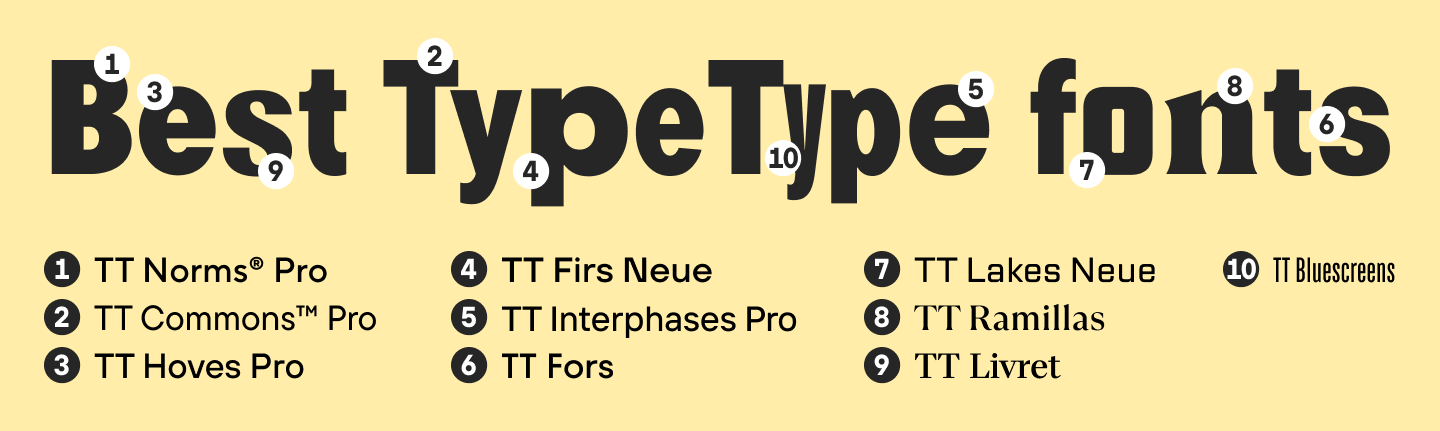
Below is not a dry catalog, but a practical overview: what each typeface is useful for, why designers love it, and where it logically fits instead of the usual Helvetica, Roboto, or Montserrat.
TT Norms® Pro: The Modern Standard for a Universal Grotesque
TT Norms® Pro is TypeType’s flagship geometric grotesque and one of the studio’s main bestsellers. The font has undergone several revisions over eight years, consistently ranks high on international marketplaces, and is used by major brands worldwide.
Features and Style:
- Geometric foundation with soft optical corrections;
- Huge range of weights, including Condensed and Expanded;
- Variable font and monospaced subfamily for code and tables.
Areas of Application:
- Branding and logos (an alternative to Proxima Nova and Helvetica);
- Interfaces and websites where clean, neutral typography is needed;
- Navigation, infographics, presentations.
If you need a “go-to” universal font for a studio pipeline—TT Norms® Pro easily claims the role of the main workhorse typeface.
TT Commons™ Pro: The Workhorse Replacement for System Fonts
TT Commons™ Pro grew from the concept of an “everyday” common font—hence the name. This is the case when a designer stops habitually using Times New Roman or Arial and switches to a modern, carefully constructed grotesque.
Features:
- Neutral character, good readability in text;
- Rich set of OpenType features and language support;
- Suitable for both small body text and large headlines.
Where to Use:
- Corporate websites and personal branding (portfolios, landing pages, presentations);
- Editorial design: articles, blogs, e-books;
- Interfaces, marketing materials, email newsletters.If you’re looking for a replacement for popular grotesques like Roboto, Lato, or Montserrat but want a more cohesive system of weights and premium quality, TT Commons™ Pro is one of the most logical solutions.
If you’re looking for a replacement for popular grotesques like Roboto, Lato, or Montserrat but want a more cohesive system of weights and premium quality, TT Commons™ Pro is one of the most logical solutions.
TT Hoves Pro: For Bold Layouts and Complex Grids
TT Hoves Pro is a large type family with four widths (Compact, Normal, Condensed, Expanded), as well as a monospaced version and variable styles.
Character: Strict, technological, with a slight industrial vibe. Feels at home in posters, navigation, and brand styles for digital brands.
- 90+ styles, including variable and mono;
- Support for over 270 languages (including Cyrillic and Latin);
- Convenient for complex typographic grids: captions, tables, microtext.
If your current favorite “strict” font is something like Helvetica Neue, it makes sense to test TT Hoves Pro as a more modern and flexible alternative for branding, digital media, and interfaces.
TT Firs Neue: Scandinavian Grotesque with Character
TT Firs Neue is inspired by Scandinavian aesthetics—minimalism, simplicity of forms, and airiness in composition. The font supports extended Latin and Cyrillic, has a variable version, and a set of OpenType features useful in branding.
Where It Shines:
- Signage, architectural and interior navigation;
- Identity for cafes, museums, creative spaces;
- Clean landing pages and promo sites.
This is an excellent choice for designers who love the Northern European visual language and want to move away from familiar grotesques like Futura or Avenir in favor of a fresher, yet still universal solution.
TT Interphases Pro: UI Typeface for Interfaces
TT Interphases Pro was originally created as a font for interfaces and digital products. In addition to a full set of weights, the typeface includes a large set of pictograms and icons visually consistent with the font forms.
Why It’s Convenient for Web and Apps:
- Soft rounding and repeating form plasticity make text easy to read at small sizes;
- Built-in icons simplify the design of systemic UI elements: menus, buttons, statuses;
- Variability of weights helps build hierarchy without switching typefaces.
If you’re developing a product site or a complex interface, TT Interphases Pro can replace the combination of a “UI font + separate icon set” and provide a more cohesive, neat visual language.
TT Fors: Grotesque with Refined Forms for Various Tasks
TT Fors is a geometric grotesque inspired by early to mid-20th century grotesques, but revised considering modern requirements for screen typography and variable fonts.
What Makes It Interesting for Designers:
- Three axes of variability in the base subfamily (weight, width, slant) and two in the display subfamily;
- In 2024, a narrow Condensed family was added, convenient for headlines, menus, and tight layouts;
- Rich set of OpenType features (ligatures, stylistic alternates, arrows, circled numbers).
TT Fors is perfect for brands that want to look modern but without excessive eccentricity. It could easily become your favorite grotesque for identity in 2025.
TT Lakes Neue: Technology, Functionalism, and Games
TT Lakes Neue is a family inspired by Finnish functionalism. The typeface includes an extended set of weights (including Compressed, Condensed, Extended, Expanded), improved technical features, and a revised character.
Its use in the interface of the game SnowRunner—a popular off-road racing simulator—is particularly noteworthy. This again shows that the typeface performs confidently in dynamic interfaces, numbers, and status displays.
Where to Apply:
- Game interfaces and HUDs, dashboards, control panels;
- Tech branding, fintech, logos with an industrial character;
- Transport navigation, boards, diagrams.
If you’re looking for a grotesque with a technological texture that remains legible even in microtext, TT Lakes Neue is a very strong candidate.
TT Ramillas: Modern Serif with Character
TT Ramillas is a contrasted serif with small flared serifs, smooth transitions, and expressive details in Cyrillic. The typeface received the Modern Cyrillic award, and the TypeType website directly states that it will enhance any project and is already used on thousands of sites worldwide.
Ideal Tasks for TT Ramillas:
- Premium branding (wine, fashion, cosmetics, cultural institutions);
- Book and magazine covers, editorial design;
- Large display headlines paired with a calmer text typeface (e.g., TT Livret or TT Commons™ Pro).
This is an excellent choice when you need to emphasize expertise, status, and aesthetic depth without an “old-fashioned” serif feel.
TT Livret: Functional Serif for Editorial Design
TT Livret is a modern serif with two subfamilies: a calm text version and an expressive display version.
Advantages for Layout Designers:
- High readability in long texts due to balanced proportions;
- Expressive display weights for headlines and leads;
- A good choice for print and digital magazines, long-reads, e-books.
If your current typography is built on classics like Garamond or Georgia, TT Livret will provide a similar level of reading comfort but with fresher forms and modern Cyrillic.
TT Bluescreens: Narrow Geometric Grotesque for Accents
TT Bluescreens is a geometric grotesque with narrow proportions that retains neutrality while remaining memorable.
How It’s Useful for Designers:
- Excellent for information-dense interfaces and mobile screens;
- Provides expressive vertical accents in posters;
- Convenient for tabular data, news feeds, compact menus.
If you love narrow grotesques in the spirit of DIN but want a more flexible typeface with modern Cyrillic and thoughtful variability, it’s worth testing TT Bluescreens in real layouts.
Best Free TypeType Fonts
What Free Fonts Are Available from TypeType
TypeType has several formats of “free” fonts:
- The “Free Fonts” project: some TypeType fonts are distributed under free licenses for personal and commercial tasks.
- Trial versions of commercial fonts, which can be downloaded for free for testing, prototypes, and presentations.
Can Free Fonts Be Used in Commercial Projects?
- Fonts with free licenses from the “Free Fonts” project may allow commercial use, but terms must be checked in each specific case;
- Trial versions under a separate license agreement are intended only for preview, testing in mockups, and internal demonstration—without the right for final commercial use.
So, the best free fonts are not just “files downloaded for free from the internet,” but professional typefaces with a transparent license that a designer can present to a client.
How to Safely and Correctly Download Free Fonts
- Download fonts only from the official TypeType website or reputable platforms (e.g., Google Fonts for other typefaces).
- Always open and read the license agreement: it determines whether the font can be used in a commercial task or only in personal projects.
- Store licenses in the project folder along with source files—this simplifies work with lawyers and tenders.
- Do not send original font files to clients if the license agreement prohibits it.
How to Choose the Best Font for Your Project
TypeType covers the topic of choosing a typeface in detail in the articles “How to Choose a Font: A Comprehensive Guide for Designers” and “Fonts in Design: Types, Categories, Characteristics, and Styles.” Below is a brief practical checklist.
Recommendations for Branding and Logos
- For logos and identity, many designers still use Proxima Nova, Helvetica, and other mass-market fonts. TypeType separately covers the topic of alternatives and offers its own solutions—in particular, TT Norms® Pro and TT Commons™ Pro.
- It’s important to choose a typeface that will last a year, five years, or more without the logo feeling “outdated.” Universal grotesques like TT Norms® Pro, TT Fors, and TT Hoves Pro provide exactly that kind of durability.
- For premium brands, serifs TT Ramillas and TT Livret work well: they add depth and status while remaining legible even at small sizes.
Tip: Create a “font board” with your favorite typefaces for different brand types and observe how they perform in real projects.
Which Fonts Are Suitable for Web Design and Digital Products
- For main text and UI elements, neutral grotesques are most often used, including TT Commons™ Pro, TT Interphases Pro, TT Fors, and TT Lakes Neue.
- It’s important to check the font’s performance in different browsers and on different platforms (Windows, macOS, Android, iOS)—system rendering can sometimes “break” overly delicate typefaces.
- Don’t limit yourself to Google Fonts only: in professional projects, high-quality commercial typefaces often pay for themselves on the first major order due to uniqueness and stability.
Which Typefaces Are Best for Editorial and Print Design
- For long texts, choose text serifs with a focus on comfortable reading: TT Livret, TT Ramillas in text weights.
- For headlines and display tasks, the contrasted weights of these same typefaces or grotesques like TT Bluescreens and TT Firs Neue are suitable.
- In packaging and labels, combined pairs like “strict grotesque + expressive serif” work well—TypeType covers such combinations in more detail in the article about the best fonts for packaging and labels.
Where to Download TypeType Fonts
Official Website and Licenses
All TypeType fonts are available in the catalog on the official website. This page details license types and typical use cases: web, apps, outdoor advertising, video, games, servers, etc.
Solutions for Studios, Agencies, and Large Teams
If you are a studio, agency, or in-house team of a large brand, the most convenient option is to use a TypeType font subscription. It provides constant access to the collection, allows for optimized team licensing, and eliminates bureaucracy with each new project.
Conclusion
A correctly chosen font is not a decorative detail but the foundation of a brand’s visual communication. Research on the influence of fonts on perception confirms: typography affects emotions, trust, and ease of interaction with a product.
In this review, we’ve compiled a list of top TypeType fonts that are convenient for professional designers to work with: from universal grotesques TT Norms® Pro and TT Commons™ Pro to characterful serifs TT Ramillas and TT Livret and the narrow display TT Bluescreens. To start, you can use the best free fonts with open licenses or trial versions, and for long-term projects—purchase commercial licenses or get a subscription.
Explore the entire TypeType font catalog and find your favorite typefaces for branding, web, editorial, and packaging design.
FAQ
What Fonts Are Considered the Best for Graphic Designers in 2025?
In 2025, universal geometric grotesques and functional serifs are especially in demand: TT Norms® Pro, TT Commons™ Pro, TT Fors, TT Hoves Pro, TT Firs Neue, TT Interphases Pro, TT Lakes Neue, TT Ramillas, TT Livret, and TT Bluescreens. They cover most tasks—from logos and UI to editorial and game interfaces.
Which Fonts Are Suitable for Logos and Branding?
For logos, neutral yet expressive grotesques (TT Norms® Pro, TT Commons™ Pro, TT Fors, TT Hoves Pro) and premium serifs (TT Ramillas, TT Livret) are most often chosen. They scale well, don’t lose quality in different formats, and support a long identity lifespan.
Where Can I Download Professional Free Fonts?
Free fonts can be downloaded in the “Free Fonts” section on the TypeType website, and trial versions of commercial typefaces can be used for testing. For other projects, fonts from open platforms like Google Fonts are suitable, but the quality and uniqueness of commercial typefaces are generally higher.
Can I Use Free TypeType Fonts in Commercial Projects?
Yes, but only if expressly permitted by the license terms. Typefaces from the “Free Fonts” collection allow commercial use, while trial versions are intended only for preliminary testing and cannot be used in final commercial design. Always check the license text before use.
Which Font Should I Choose for Web or UI Design?
For web and UI design, TT Commons™ Pro, TT Interphases Pro, TT Fors, TT Lakes Neue, and TT Norms® Pro are suitable. They render well on screens, have a wide range of weights, and support complex interface tasks, including tables, panels, and mobile versions.
How Do Professional Fonts Differ from Standard System Fonts?
Professional fonts like TypeType typefaces have extended language support, thoughtful character sets, optical corrections for small and large sizes, testing in real conditions, and clear licenses for commercial and personal use. System fonts are simpler, less flexible, and often not suitable for unique branding.
What New TypeType Fonts Have Been Released in Recent Years?
Among recent releases and major updates in 2025 are the neo-humanist serif TT Regins, modern high-contrast sans TT Quaris, the updated bestseller TT Commons™ Pro with Arabic language support.
Do I Need a License to Use a Font in a Commercial Project?
Yes. Any font is an object of intellectual property, and a license is required for its use in a commercial project: desktop, web, app, video, game, outdoor advertising, etc. TypeType explains this in detail in its licensing guide and on the licenses page. Violating a license can lead to legal claims, fines, and reputational risks for the brand.